
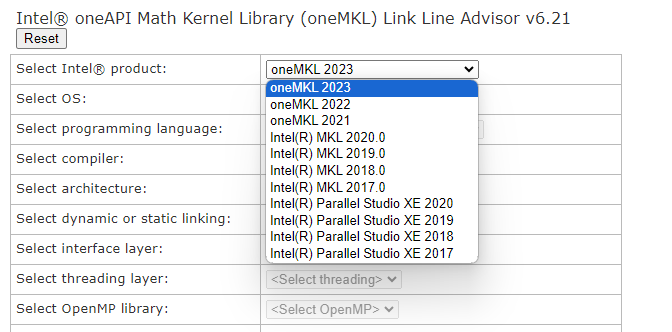
Intel Math Kernel Library is a software package from Intel that supplies optimized mathematical routines for scientific, engineering, and high-performance computing applications on Windows. It provides highly tuned implementations of linear algebra, fast Fourier transforms, vector math, and related numerical functions that can accelerate computation on Intel processors. Developers link the library into their programs to gain performance improvements without rewriting core algorithms.
| Library Module | Primary Capability | Target Workload | Windows Integration Note |
|---|---|---|---|
| BLAS / CBLAS | Vector-vector, matrix-vector, matrix-matrix kernels | Dense linear algebra building blocks | Linkable via Intel oneAPI or standalone MKL DLLs |
| LAPACK | Factorizations, eigensolvers, least-squares | Scientific and engineering solvers | Thread-safe with Intel OpenMP runtime on Win64 |
| FFT / DFTI | Multi-dimensional discrete Fourier transforms | Signal and image processing pipelines | Supports both single and double precision under Windows ABI |
| Sparse BLAS & Solvers | CSR/CSC sparse matrix primitives and direct/iterative solvers | Finite-element and graph analytics codes | Works with Microsoft Visual C++ and Intel compilers |
| Vector Math & Statistics | Element-wise transcendentals, RNG, summary stats | Monte Carlo and data-analytics loops | Dispatches to AVX2/AVX-512 when CPUID allows on Windows hosts |
| ScaLAPACK cluster layer | Distributed-memory dense linear algebra | HPC jobs spanning multiple Windows nodes | Requires MPI (Intel MPI or MS-MPI) co-installation |
Pros
- Highly optimized mathematical routines deliver strong performance on Intel processors
- Comprehensive coverage of BLAS LAPACK FFT and other core numerical functions
- Widely adopted in scientific engineering and high-performance computing workloads
- Supports multiple languages and integrates well with common development tools
- Regular updates maintain compatibility and efficiency improvements over time
Cons
- Performance is tuned mainly for Intel CPUs and can be weaker on others
- Library size is large and can increase application footprint
- Setup and linking can be complex for some build environments
Download